ACT: Know Your Rights
Where I’m Coming From
I recently attended a Know Your Rights workshop run by Wind of the Spirit. I was running late and literally ran into the MCMD headquarters in Morristown, nose running from the icy wind. Of course, I came barreling in while the facilitator, Karol, was in the middle of leading an intersectional prayer. Quieting down as quickly as I could, I close my eyes and join.
Like all of you reading this, I have been outraged, disgusted, overwhelmed, and horrified by the ongoing events of our country over the last year. (Can you believe it’s only been one year since he swore his second oath of office?) I feel like my head is constantly spinning, spiraling, and sputtering. Tight chested, I have spent hours upon hours scrolling and reading about the horrors that have been going on for the last twelve months. But I am not one to sit back and take abuse. I meet it head-on, be it against me, a loved one, or my neighbor.
You’ve seen my posts and reposts on social media. I’ve made my donations. I go to the protests. I call my representatives on the phone (and loudly complain about their bad behavior on socials as well). I read, I share, I speak, I listen.
Yet all of this was not enough for me. I want to do more.
A friend invited me to join a group going to a Know Your Rights workshop, and I jumped at the opportunity. I am so glad that I did, and I recommend that if you see the chance to take this, or a similar workshop, do it!
Key Takeaways
1. Understand How We Got Here
If you know me in real life, then you’ve also heard me talk about how important the 5-4 Podcast (a podcast about how much the Supreme Court sucks) has been to me through this. Understanding the history of the demolition of our rights and the systemic dismantlement of democracy orchestrated by the far-right has lit a fire in me. I consider this podcast my re-education on Civics.
Short of listening to three entertaining lawyers break down landmark cases for hours on end, what you need to know is that immigration rights (or lack thereof) is not merely the fault of the right. The facilitator reminded us all that Obama’s nickname was “Deporter-in-Chief.” The state of our nation’s policies has both the right and the left to blame.
Let us not forget that treating non-white Protestants from England like scum is the longest-lasting legacy of the United States. This has been the mode of operation since Day 1.
2. De-escalate and Non-Violence
The name of the game is non-violent de-escalation. And, to be honest, in all the anxiety-ridden times I’ve imagined how this might go in my head, I thought about making a scene and doing everything in my power to get between agents and their target. Let’s say I learned my lesson during these discussions.
As a white person, especially in the terrifying moment of being between a person of color and a could-be murderer of an ICE agent… It’s hard to remember to de-center myself and to let go of what I think is best. If I come in hot and raise the temperature of the interaction, the likelihood of me getting seriously or fatally hurt is much lower than that of whoever they’re trying to assault. Aiming to keep everything as cool and calm as possible is the safest bet for everyone.
Take the person in crisis’s lead.
My notes say: shut up, step back, document.
3. Ask the Right Questions of a Detainee
Let’s say you’re responding to a situation where a victim is being detained. You do not want to ask them their name. While your intentions are in the right place, you do not want to give ICE any information they can use against this person inadvertently.
The only questions you want to ask them are if they have a lawyer and what their lawyer’s name is. Then document as much of the situation as you can.
Wind of the Spirit emphasized the importance of getting out in your community and getting to know everyone, so that you don’t have to ask them their name when it’s too late.
4. Videos are for Lawyers
Speaking of lawyers, if you’re out there filming ICE, they strongly suggest not uploading the videos to social media or NJ’s new portal. These videos are evidence for lawyers to get their clients out of ICE’s concentration camps.
The evening went quickly, but when this topic came up, a participant pushed back a little, saying that, because of the videos on social media, we knew the truth about what happened to Alex Pretti. While true, Karol (a lawyer) responded very quickly, “Ask his lawyer if they’re happy that video is out there.” She explained that viral videos are very difficult to submit as evidence in court.
While we want to raise awareness of what is going on, Karol pointed out that we must ask ourselves why we’re recording. If it’s for likes on the internet, sure, post it to social media. If you trust the government, sure, upload it to the NJ portal. But if it’s to help people escape their situation, then find their lawyer and send it to them.
5. Other Dos and Don'ts
I’m going to go through these points quickly as I don’t feel they require elaboration:
If you are asked to show ID to an ICE agent, you may not have to (and this is where the law is pretty fucked up):
- If you are a US citizen, you do not have to show ID
- If you are an immigrant without a visa or other paperwork, you do not have to show ID
- If you are an authorized immigrant of any kind, you are required to show ID
If you want to invoke your 5th Amendment Right to remain silent, you must verbalize that you are invoking your right. Being silent is not enough (the law changed in the Berghuis v. Thompkins Supreme Court case, which ruled that a suspect must verbally invoke the right to remain silent in 2010).
Do not consent to any photos or facial scans; try to get a video or voice recording of you not giving permission
Look up Judicial vs Administrative warrants, so you know the visual differences
- Why is it important? You don’t have to comply with Admin warrants. Only Judicial.
- Check warrants for any errors or incorrect information (often they show up with blank or otherwise wrong warrants, and people allow them to conduct searches or enter their homes, thinking they are legitimate)
For businesses: mark employee-only areas, keep doors closed/locked. They cannot go into those private areas without consent or a warrant (technically)
Whistles are only recommended in communities that have thorough training on how to use them
1-888-DIRE-SOS is currently the best hotline we have in NJ for rapid responders to the situation
Calling the police… up to you, but they can’t do anything. I would not.
STAY AS CALM AS HUMANLY POSSIBLE
6. They Don’t Follow the Law
Knowing your rights is really important, but that doesn’t mean that ICE will be like, “Oh, my bad” when you point out that yours or someone else’s rights are being trampled on.
For example, above, I said, “Do not consent to any photos or facial scans.” Even if you say you do not consent, they will probably still take your picture to add you to a database. Why does it matter to say you don’t consent? If, by chance, you end up in court, it will help your case to have recorded yourself not consenting. I don’t know the ins and outs of all that law, and we didn’t get into it at the workshop… but I think, generally, it makes sense to collect as much evidence as possible that ICE isn't following the law in the hopes of justice… one day.
Anyone who works in or near law enforcement knows that our rights are routinely disregarded in this country. However, Knowledge Is Power. Know your rights, document yourself when invoking them, or when your rights are ignored. It may help you or someone else in the end.
Below is a “Know Your Rights” card that they handed us toward the end of the workshop.
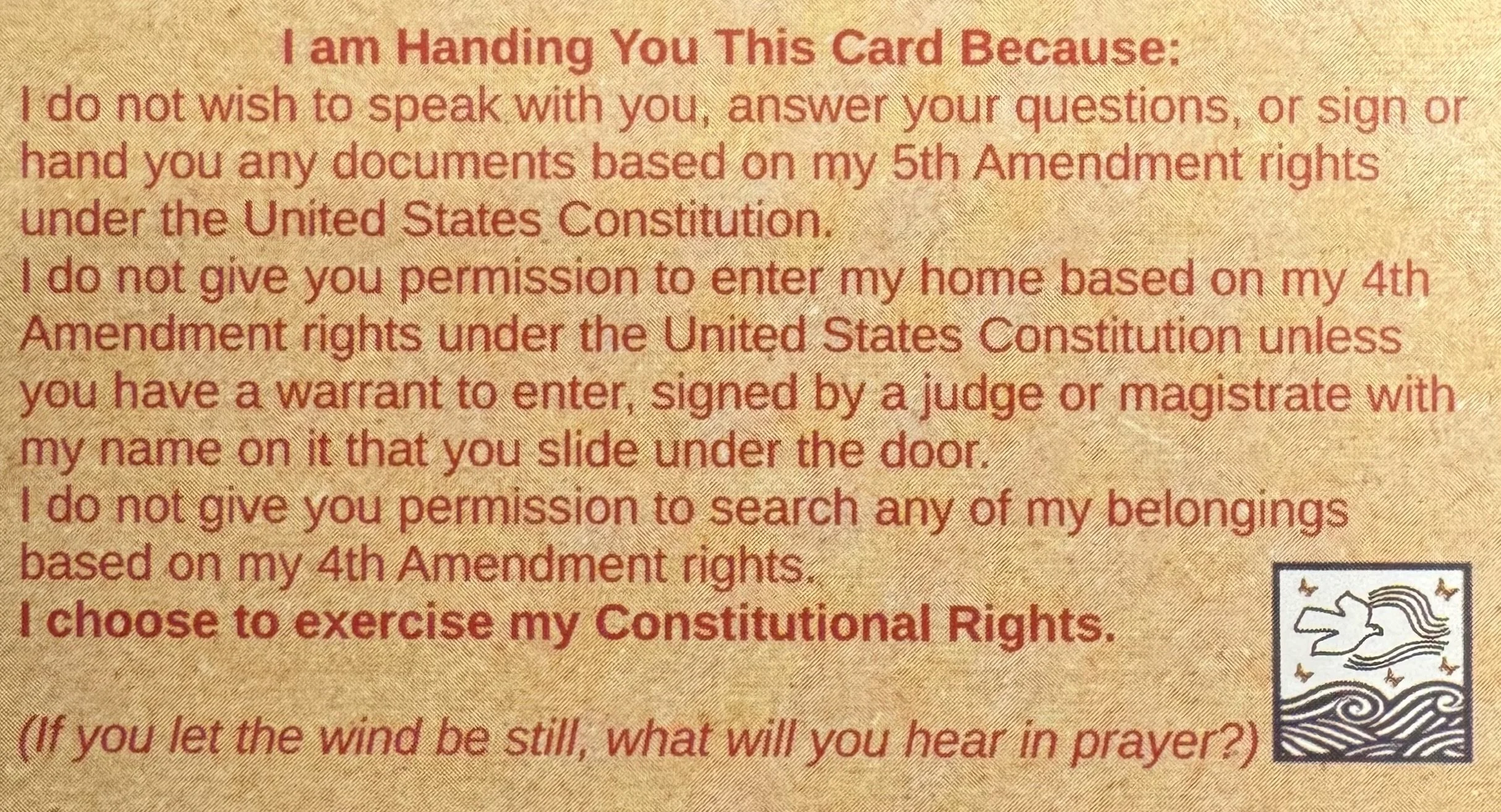
I am Handing You This Card Because:
I do not wish to speak with you, answer your questions, or sign or hand you any documents based on my 5th Amendment rights under the United States Constitution.
I do not give you permission to enter my home based on my 4th Amendment rights under the United States Constitution unless you have a warrant to enter, signed by a judge or magistrate with my name on it that you slide under the door.
1 do not give you permission to search any of my belongings based on my 4th Amendment rights.
I choose to exercise my Constitutional Rights.
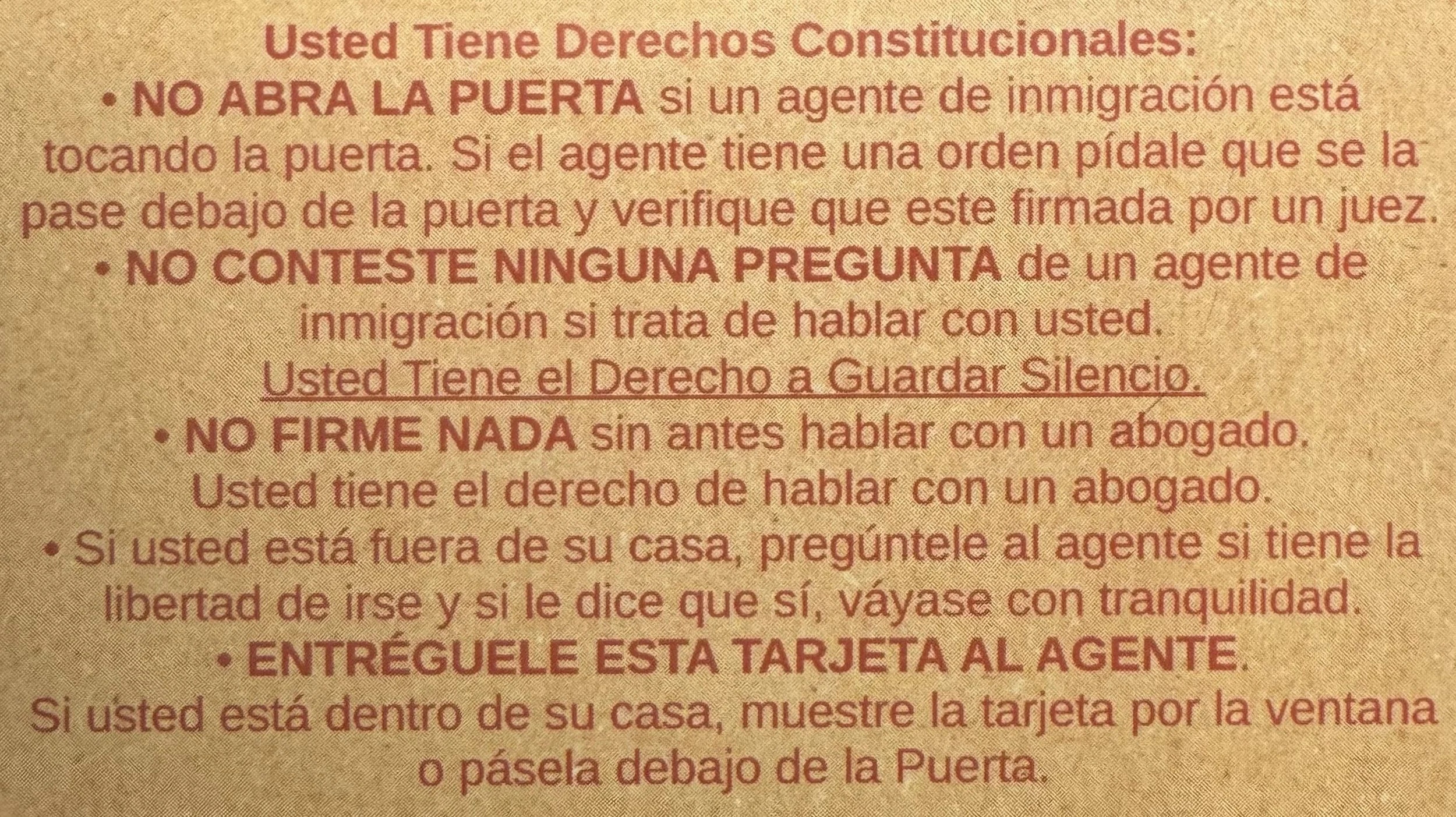
Usted Tiene Derechos Constitucionales:
NO ABRA LA PUERTA si un agente de inmigración está tocando la puerta. Si el agente tiene una orden pidale que se la pase debajo de la puerta y verifique que este firmada por un juez.
NO CONTESTE NINGUNA PREGUNTA de un agente de inmigración si trata de hablar con usted.
Usted Tiene el Derecho a Guardar Silencio.NO FIRME NADA sin antes hablar con un abogado.
Usted tiene el derecho de hablar con un abogado.Si usted está fuera de su casa, pregúntele al agente si tiene la libertad de irse y si le dice que sí, váyase con tranquilidad.
ENTRÉGUELE ESTA TARJETA AL AGENTE.
Si usted está dentro de su casa, muestre la tarjeta por la ventana o pásela debajo de la Puerta.

Next Steps
Some homework I gave myself is to look up the NJ Immigrant Trust Act. It is a law that former Governor Murphy did not fully sign, and Sherrill has yet to sign. The Wind of the Spirit felt strongly that it was very important that all parts of the Trust Act become law.
I will continue to learn, to share, and to listen.
Let me know what you’re up to. How are you fighting? How are you finding hope?